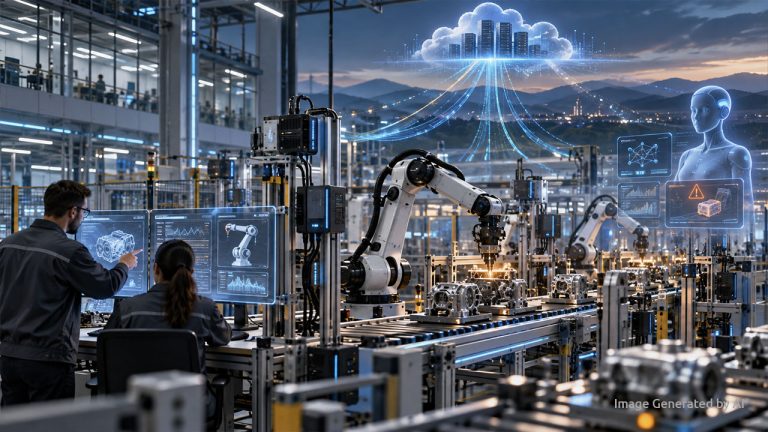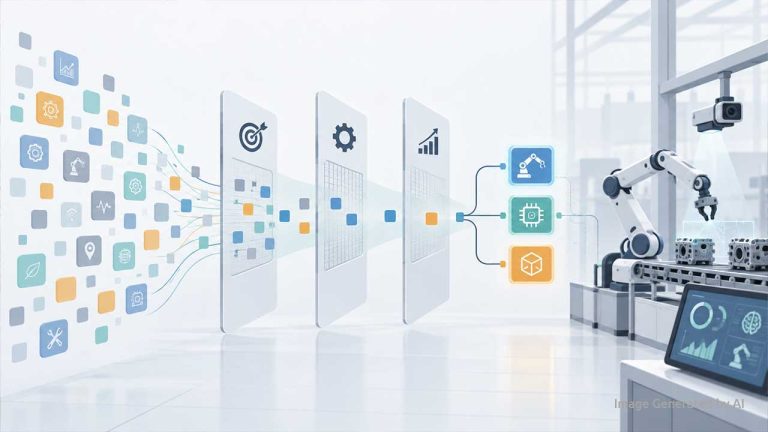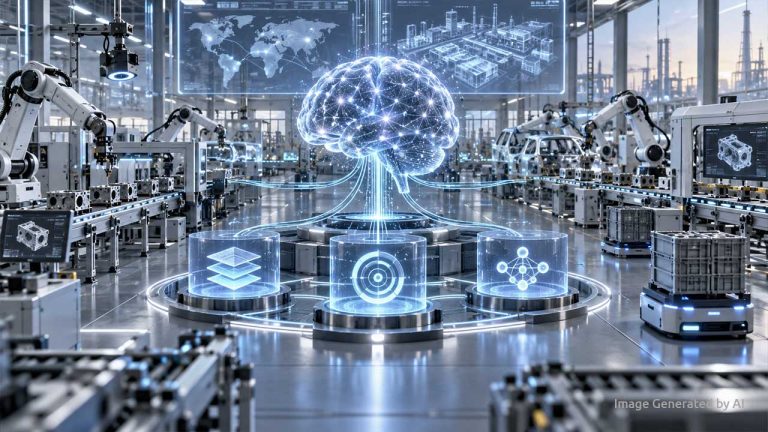

AIoT, the convergence of artificial intelligence and the Industrial Internet of Things, is reshaping how industrial systems sense, decide, and act without waiting for human intervention. At IIoT World, we define AIoT as the architectural pattern in which machine learning models are embedded directly into connected device layers, enabling real-time inference at the point of data generation rather than in a distant cloud. The result is a new class of industrial operation: one where a temperature sensor does not merely report a value but interprets it, correlates it with vibration and pressure context, and triggers a corrective action within milliseconds. This article explains what AIoT is, how it differs from standard IoT deployments, and where it is delivering measurable outcomes across manufacturing, energy, and infrastructure sectors.
The Convergence of IoT and AI
The industrial Internet of Things enables companies to connect physical devices such as sensors, machines, or vehicles and capture data in real time. This data provides valuable insights into machine conditions, process flows, and the overall efficiency of operations. The integration of AI now elevates the potential of this data to a new level. AI algorithms not only analyse past patterns but also make predictions, automate decisions, and continually learn to deliver even better outcomes.
The combination of AI and IoT creates a platform where data is not merely collected but also interpreted and translated into immediate actions. While IoT provides the “eyes and ears,” AI serves as the “brain” that processes this information. Together, these technologies can optimise processes, reduce costs, and drive innovation.
Novel Applications in Industry
AIoT has already given rise to numerous industrial applications. One example is the autonomous control of production facilities. In modern factories, AIoT enables machines to be controlled automatically and production processes to be dynamically adjusted to external conditions or operational requirements. AI can analyse production data, identify optimal parameters, and make real-time adjustments. This leads to higher productivity and improved quality assurance.
Another application area is logistical optimisation. AIoT allows supply chains to be monitored in real time, predicting bottlenecks or delays. This is particularly valuable in times of global uncertainties threatening supply chains. AI can optimise transport routes, manage inventory efficiently, and reduce operational costs.
Predictive maintenance management is another area benefiting from AI optimisation. Traditionally, maintenance is either reactive – after a breakdown – or preventive, based on rigid schedules. Both approaches result in inefficient operating costs: either from unplanned downtime or unnecessary maintenance work. IoT uses sensors to collect real-time data on machine conditions, and AI analyses this data. This enables companies to identify potential issues before they arise and carry out maintenance only when necessary. This drastically reduces downtime and extends the lifespan of equipment.
Data Sovereignty and Security in AIoT
The increasing connectivity and data processing in AIoT also pose challenges, particularly regarding data security and privacy. Companies must protect sensitive operational data while reaping the benefits of data-driven innovations. This requires a holistic approach encompassing technological, organisational, and legal aspects, especially in light of recent European legislation such as the Cyber Resilience Act, the Data Act, and the AI Act.
Data sovereignty is a central concern in the AIoT ecosystem. Companies want to maintain control over data and ensure it does not fall into third-party hands. Innovative technologies like edge computing play a key role here. Unlike cloud solutions, where data is centrally stored and processed, edge computing enables data processing directly at the source – such as on a machine or local server. This not only minimises latency but also reduces the attack surface for cybercriminals.
Additionally, companies are increasingly adopting encryption technologies and zero-trust architectures to minimise security risks. In a zero-trust environment, every interaction – whether between devices, users, or applications – is verified and authenticated. This helps companies protect their systems from unauthorised access without compromising efficiency or functionality.
Challenges and Trends in the AIoT Ecosystem
Despite its promising potential, AIoT faces several hurdles. One major challenge is interoperability. Many companies use IIoT devices and platforms from different manufacturers, which are not always seamlessly compatible. This complicates the implementation of integrated AIoT solutions and necessitates standardised interfaces and protocols. IIoT platforms such as Cumulocity can integrate various services and devices. A well-chosen platform facilitates the integration of new devices, enables easy scaling, and supports the flexible adaptation of an IIoT strategy. It also allows integration with other systems and technologies, such as ERP or CRM systems, thereby embedding IIoT technologies into existing business processes. Moreover, robust platforms offer specialised security features to protect connected devices from potential cybercriminal attacks.
Another critical aspect is data preparation. In IoT environments, data quality is often poorer than businesses assume. Applying AI to inadequately prepared data produces subpar models that fail to deliver expected results. Therefore, it is crucial to prepare and enrich data appropriately for analysis using a reliable IoT platform.
A further challenge is the skills shortage. Developing and implementing AIoT systems requires expertise in fields such as data analysis, machine learning, and cybersecurity. The demand for skilled professionals exceeds current supply, prompting companies to invest in training and development programmes.
At the same time, exciting trends are emerging that will shape the AIoT ecosystem in the coming years. One such trend is the use of generative AI, which not only analyses data but also generates new designs or optimisation proposals. Another trend is the integration of 5G technologies, which enable ultra-fast and reliable connectivity. This is particularly important for applications requiring high bandwidth or low latency, such as autonomous vehicles or real-time controls.
Conclusion: AIoT as an Industrial Game-Changer
The combination of IoT and AI has the potential to fundamentally transform the industrial landscape. AIoT not only allows for more efficient processes and cost reductions but also opens the door to entirely new business models. Companies that adopt this technology early can secure a decisive competitive advantage.
About the Author
 As Chief Product Officer, Dr. Jürgen Krämer is responsible for Cumulocity’s product and service portfolio. He oversees the Product Management & Marketing, Professional Services and Partner Ecosystem teams. Together with his team, he leads the vision and strategy formation to drive innovation and sustainable platform growth, while cultivating a mindset of product and service excellence that enhances the customer experience.
Related articles:
Frequently Asked Questions: AIoT in Industrial Settings
1. What is AIoT and how is it different from standard IoT?
Standard IoT (Internet of Things) refers to networks of connected devices that collect and transmit data to a central platform, typically a cloud or on-premises server, where that data is analyzed and acted upon. AIoT (Artificial Intelligence of Things) goes further by embedding AI inference capabilities directly into the devices or edge nodes themselves, enabling local decision-making without requiring a cloud round-trip. The practical difference is latency, resilience, and bandwidth: an AIoT-enabled vibration sensor on a CNC machine can detect an anomalous signature and trigger a maintenance alert in milliseconds, even if the plant’s network connection is interrupted. Standard IoT would require that data to reach a central server before analysis could begin. For industrial applications where milliseconds matter, process control, safety systems, quality inspection, this distinction is operationally significant. For a deep dive into edge AI architecture for industrial operations, see IIoT World’s guide to edge AI and industrial data context.
2. What are the primary AIoT use cases in manufacturing and energy?
In manufacturing, leading AIoT use cases include: edge-based predictive maintenance (AI models embedded in sensor nodes or edge gateways detect equipment degradation without cloud dependency), AI-powered visual quality inspection (computer vision running on edge hardware inspects products at line speed), and autonomous material handling (AI-enabled AGVs and cobots that navigate and adapt to shop floor conditions in real time). In energy, primary AIoT applications include: distributed energy resource (DER) management where edge AI balances solar, storage, and grid load at the substation level without centralized coordination; intelligent pipeline monitoring where AI-equipped sensors detect leaks or pressure anomalies; and smart meter analytics where edge AI identifies consumption anomalies and grid faults locally. Both sectors are increasingly deploying AIoT as part of broader edge AI strategies to reduce cloud dependency, improve response times, and maintain operations during connectivity disruptions. Explore how manufacturers are applying AIoT to predictive maintenance specifically in IIoT World’s predictive maintenance cost savings analysis.
3. What infrastructure does an organization need to deploy AIoT successfully?
Successful AIoT deployment requires four foundational elements. First, edge-capable hardware: devices or gateways with sufficient compute (typically a neural processing unit or GPU-enabled SoC) to run AI inference models locally, examples include NVIDIA Jetson, Intel Movidius, and purpose-built industrial AI edge appliances. Second, a reliable data pipeline: a mechanism to move training data from edge to cloud (or on-premises ML platform) for model development, and to push updated model versions back to edge devices, this is the MLOps layer for AIoT. Third, connectivity management: since AIoT is designed to operate in degraded or disconnected states, the architecture must define what the device does when connectivity is lost and how it resynchronizes when it returns. Fourth, OT security integration: edge AI devices expand the attack surface of industrial networks; they must be managed within the organization’s ICS/OT security framework, with firmware update controls, network segmentation, and anomaly detection applied at the edge layer. AIoT expands the OT attack surface significantly, review the latest ICS/OT cybersecurity trends to understand the security implications.