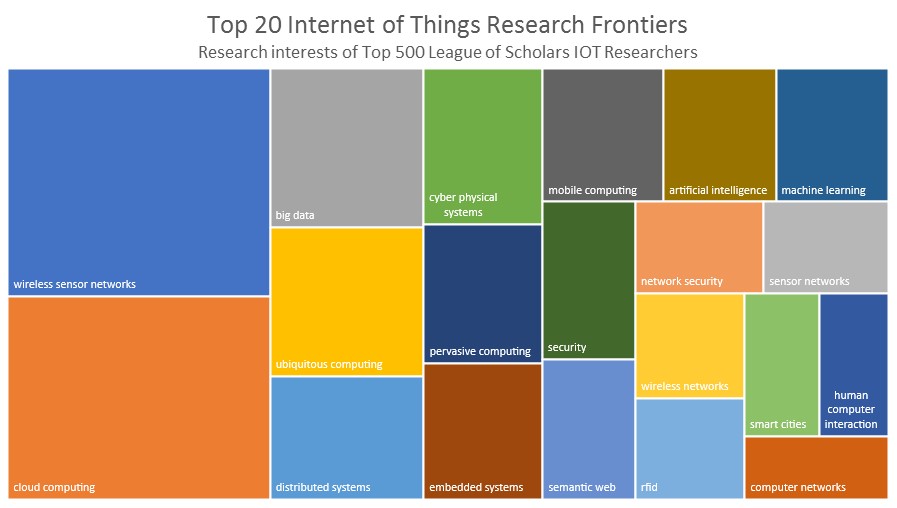
In a 2017 League of Scholars ranking, wireless sensor networks and cloud computing dominated academic focus among the world’s top 500 Internet of Things researchers, at 30% and 27% respectively. This ranking, compiled by co-founder Paul X. McCarthy, mapped the research frontiers shaping Industrial Internet of Things development across universities, companies, and government organizations.
What Is the Industrial Internet Consortium?
The Industrial Internet Consortium is an organization cofounded in March 2014 by five major companies to accelerate Industrial Internet growth. Its membership includes technology innovators, vertical market leaders, IoT researchers, AI leaders, universities, and government organizations working together to identify and promote best practices in IIoT development.
From my perspective, it is imperative that in this relatively young research field there are involved not only companies but IoT researchers, leaders and universities too because, all these entities, working together, are the primary drivers of innovation and evolution.
As businesses are trying to leverage every opportunity regarding IoT by trying to find ways to partner with top universities and research centers, here is a list of the Top 20 co-occurring topics of the Top 500 Internet of Things Authors in the academic field. This gives an idea of the IoT research frontiers of the leaders.
Almost one in three IoT researchers are interested in cloud computing and wireless sensor networks. Only one in 13 are interested in mobile computing, Artificial Intelligence, and Machine Learning; one in 14 – in Cybersecurity and even less, one in 20 are interested in smart cities (this data represents explicit interests expressed via keywords used within the published research to date of the top500 researchers & leaders in IOT).
What Do the Top 500 IoT Researchers Study?
According to League of Scholars, which ranked the top 500 Internet of Things authors in academia, wireless sensor networks led all research interests at 30%, followed by cloud computing at 27%. Only about one in thirteen of these researchers focus on artificial intelligence, machine learning, or mobile computing, and fewer than one in twenty study smart cities.
- wireless sensor networks 30%
- cloud computing 27%
- big data 12%
- ubiquitous computing 12%
- distributed systems 10%
- cyber physical systems 9%
- pervasive computing 8%
- embedded systems 8%
- mobile computing 8%
- artificial intelligence 8%
- machine learning 8%
- security 7%
- semantic web 7%
- network security 6%
- sensor networks 6%
- wireless networks 6%
- rfid 6%
- smart cities 5%
The statistics and the image were provided by Paul X McCarthy, Co-founder and CEO of League of Scholars.
The tool ranks scholars around the world not simply on their citations or H-Index but also by a new proprietary ranking that takes into account a range of quality and relevance factors such as the impact factor and influence of the venue, industry collaboration and public engagement via high profile media.
Using the Leagues of Scholars’ algorithm, we are planning to publish in the next weeks Top Cybersecurity and Top Industrial Automation Research Institutions and also Top Researchers in the same fields.
Check out the lists of industrial IoT companies and startups present at Web Summit 2021 and the startups we spotted at Web Summit this year, focused on clean energy and renewable energy.
FAQ
1. What were the most common IoT research topics among academic leaders in 2017?
According to League of Scholars, which analyzed the top 500 Internet of Things researchers worldwide, wireless sensor networks are the most studied topic at 30%, followed by cloud computing at 27%, big data and ubiquitous computing at 12% each, and distributed systems at 10%. Artificial intelligence and machine learning each appear in the interests of about 8% of these researchers.
2. What is the Industrial Internet Consortium and who founded it?
The Industrial Internet Consortium is an organization cofounded in March 2014 by five major companies. Its stated objective is to bring together organizations and technologies necessary to accelerate Industrial Internet growth by identifying, assembling, and promoting best practices. Membership spans technology innovators, vertical market leaders, IoT researchers, AI leaders, universities, and government organizations.
3. How does League of Scholars rank IoT researchers differently from traditional methods?
League of Scholars ranks researchers using a proprietary algorithm that goes beyond citation counts or H-Index scores. The ranking accounts for a range of quality and relevance factors, including the impact factor of the publication venue, industry collaboration, and public engagement through high-profile media. Co-founder Paul X. McCarthy provided the IoT researcher data referenced in this article.
4. How much IoT researcher interest was there in cybersecurity and smart cities?
Among the top 500 IoT researchers ranked by League of Scholars, cybersecurity attracts the interest of about one in fourteen researchers, placing it below artificial intelligence and machine learning in research priority. Smart cities receive the least attention of the tracked topics, with only one in twenty of these leading IoT researchers listing it as an area of focus.
Related Reading
Industrial AI Events in May 2026: Global Conference Guide
Securing the Convergence: OT and IT Systems in the Modern Age
Industrial Robotics: Transforming Modern Manufacturing and Beyond