

At IIoT World, we track how industrial organizations move from fragmented data collection to AI-ready operations — and DataOps is consistently the discipline that separates manufacturers who scale AI from those who stall. This four-stage maturity model gives operations leaders, data engineers, and IT/OT integration teams a structured path: from ad-hoc data pipelines and siloed historians to fully governed, context-rich data flows that feed reliable machine learning models on the shop floor. Whether you are at Stage 1 or pushing toward Stage 4, this framework helps you benchmark where you are and prioritize what to fix next.
Enter Industrial DataOps.
DataOps (data operations) is the orchestration of people, processes, and technology to securely deliver trusted, ready-to-use data to all the systems and people who require it. The first known mention of the term “DataOps” came from technology consultant and InformationWeek contributing editor Lenny Liebmann in a 2014 blog post titled, “DataOps: Why Big Data Infrastructure Matters.”
According to Leibmann:
“You can’t simply throw data science over the wall and expect operations to deliver the performance you need in the production environment—any more than you can do the same with application code. That’s why DataOps—the discipline that ensures alignment between data science and infrastructure—is as important to Big Data success as DevOps is to application success.”
DataOps for Manufacturing
DataOps solutions are necessary in manufacturing environments where data must be aggregated from industrial automation assets and systems and then leveraged by business users throughout the company and its supply chain.
HighByte developed a DataOps solution specifically designed for the manufacturing industry that allows manufacturers to create scalable models that standardize and contextualize industrial data. Over the years, we have worked with many manufacturers who are at varying stages of their DataOps implementation and have different goals.
Based on these insights, we’ve created a maturity model to help data leaders at industrial companies understand where they are on their own maturity journey—and where they need to go to achieve the results they expect.
The model defines a four-stage process.
- Data access. The data access stage is generally useful for optimizing controls and other key operational functions. However, many companies find the data is not suitable for higher-level business analytics or most use cases beyond process monitoring.
- Data contextualization. The data contextualization stage provides contextualized and standardized data points to the operations team, enabling them to compare similar data points. The Operational Technology (OT) team benefits by having analytical information they can use to make more informed operating decisions.
- Site visibility. The site visibility stage is focused on providing information payloads to business users outside of operations. This data is typically used to improve quality, research and development, asset maintenance, compliance, supply chain, and more. DataOps maturity directly enables predictive maintenance at scale — explore the real cost savings from predictive maintenance programs.
- Enterprise visibility. The enterprise visibility stage provides the broadest value to companies, allowing them to aggregate information across sites with common dashboards, metrics, and analytics. It also allows them to implement sophisticated data-driven decision making and Cloud-to-Edge automation. For a deeper look at how a Unified Namespace enables Stage 3 DataOps, see IIoT World’s guide to the Unified Namespace.
The successful attainment of each stage—and the benefits associated with them—is dependent on three parameters:
- Team
- Data handling
- Data structure
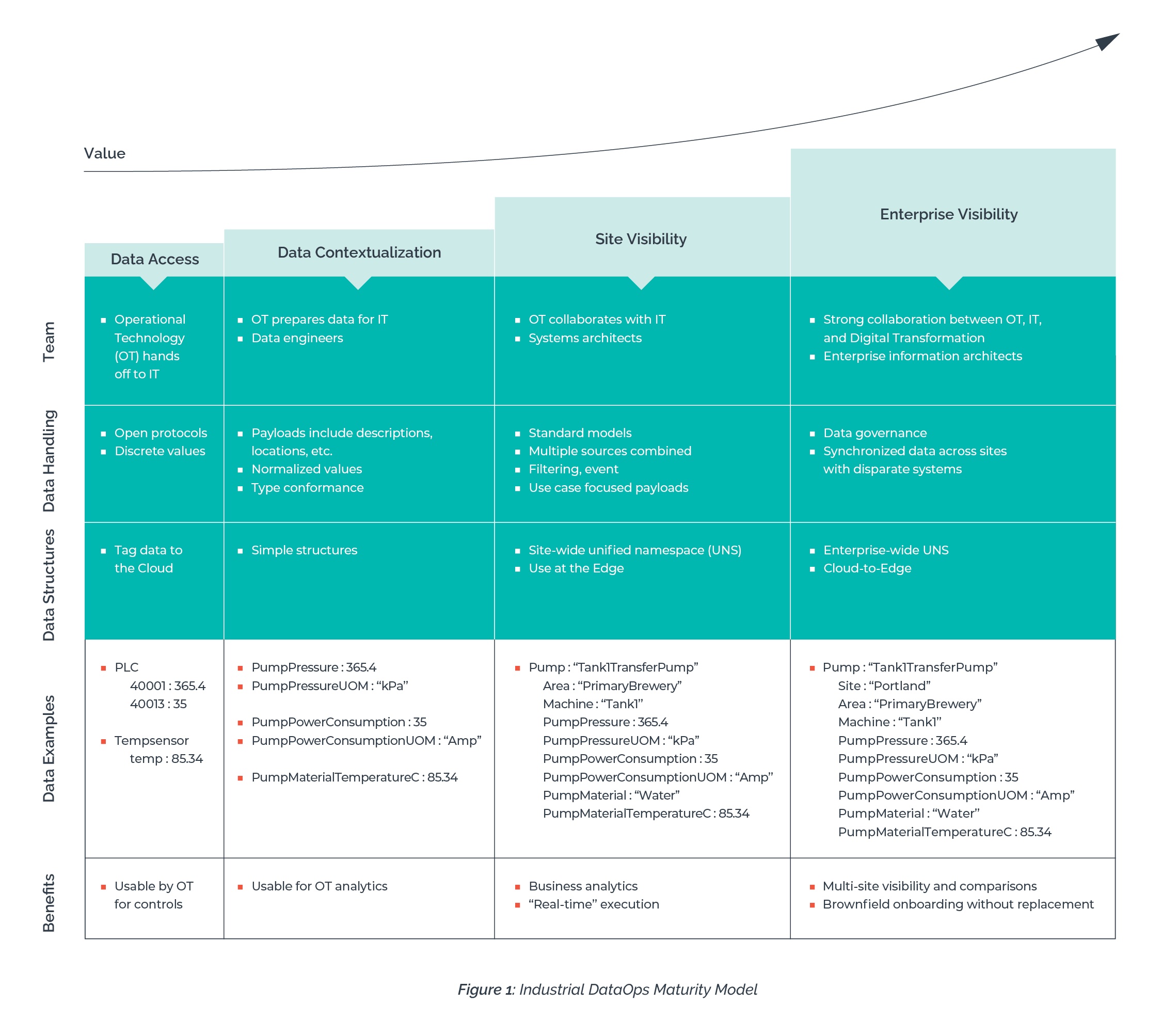
Figure 1 provides an overview of these four maturity stages and how team, data handling, and data structure impact the process. The key takeaway here is that you can’t achieve the benefits of enterprise visibility with the approach of data access.
Many companies have been sold the benefits of enterprise-wide data visibility and usage but do not recognize the data requirements to do so. Business users must work with the teams who support the factory, data must be curated, and solutions must be designed to be implemented at scale across the site and enterprise.
See how manufacturers calculate the ROI of Industrial AI investments once DataOps pipelines are in place: Industrial AI ROI: How to Measure and Maximize Returns.
To learn more about this topic, please read the full article.
Frequently Asked Questions: DataOps for Manufacturing
1. What is DataOps in manufacturing, and why does it matter for AI?
DataOps in manufacturing is a set of practices, processes, and technologies that improve the speed, quality, and reliability of data flowing from machines, sensors, and systems into analytics and AI applications. Without DataOps discipline, industrial AI projects frequently fail not because the models are wrong, but because the data feeding them is inconsistent, poorly labelled, or missing context — such as equipment ID, operating mode, or maintenance history. A mature DataOps practice ensures that the right data, in the right format, with the right metadata, reaches the right model at the right time. This is especially critical in environments with legacy OT equipment, multiple protocols (OPC-UA, MQTT, Modbus), and mixed IT/OT ownership of data pipelines.
2. What are the four stages of DataOps maturity for industrial operations?
The four-stage DataOps maturity model for manufacturing typically progresses as follows: Stage 1 (Ad Hoc) — data is collected inconsistently, pipelines are manual or non-existent, and analytics are retrospective and siloed. Stage 2 (Managed) — basic data pipelines exist, historians are connected, and teams begin standardizing data formats and tagging conventions. Stage 3 (Defined) — data governance policies are enforced, IT/OT data flows are automated, and machine learning models are fed from reliable, documented data sources. Stage 4 (Optimized) — DataOps is continuous, self-monitoring, and AI-ready, with data quality scores, lineage tracking, and feedback loops between model performance and data pipeline adjustments. Most manufacturers surveyed by IIoT World operate between Stage 1 and Stage 2, making the jump to Stage 3 the highest-leverage investment available.
3. How does a DataOps maturity model connect to predictive maintenance and Industrial AI?
Predictive maintenance is often the first Industrial AI use case manufacturers attempt — and the first one that exposes DataOps weaknesses. A predictive maintenance model requires clean, continuous, timestamped sensor data with accurate equipment metadata. When that data is missing, duplicated, or lacks context (such as which production line, which shift, or which maintenance event preceded the reading), the model produces unreliable failure predictions. Advancing from Stage 2 to Stage 3 DataOps maturity — specifically by implementing a Unified Namespace (UNS) or industrial data hub — is the single most common enabler of successful predictive maintenance deployments at scale. IIoT World covers this connection in detail across our Industrial AI and smart manufacturing coverage.