
A digital traveller is a mobile, real-time replacement for the paper job packets that guide parts through cutting, bending, and finishing in sheet metal fabrication. Paper travellers go out of date the moment a job changes, create visibility gaps for managers, and slow defect response. Digital travellers fix all three problems by connecting operators directly to live production data.
But as manufacturers across industries move deeper into Industry 4.0, paper travellers stand out as a bottleneck. They’re slow, prone to error, and disconnected from the digital ecosystem that modern manufacturing depends on. For fabricators under pressure to produce more with fewer people, staying on paper is becoming a liability.
Why Do Paper Travellers Fail on the Shop Floor?
Paper travellers fail because they cannot keep pace with job changes. When instructions are printed and handed to an operator, any subsequent update to nesting or bending requires a manual reprint and redistribution. The result is operators working from outdated versions, rework accumulating, and managers unable to see problems until delays or quality failures have already reached the customer.
Even more critically, paper creates a visibility gap. Managers and planners can’t easily see what’s happening in real time. Problems only surface after delays accumulate or quality issues reach the customer — far too late to react efficiently.
What Is a Digital Traveller in Manufacturing?
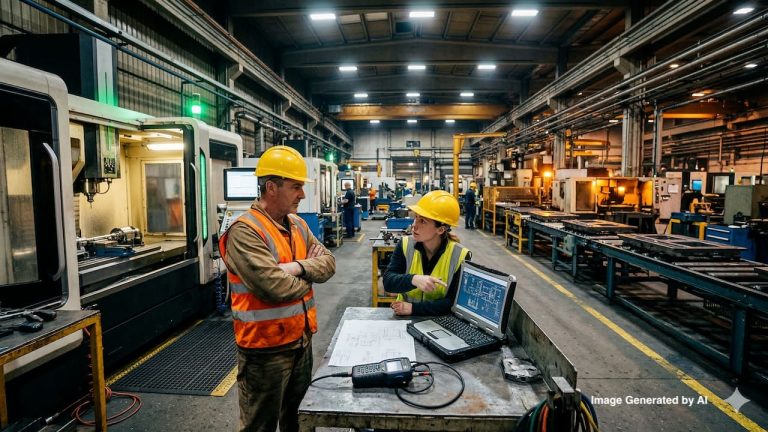
A digital traveller is a dynamic, connected workflow tool that replaces static paper job packets. Operators access live job data on mobile devices, and updates to nesting or bending instructions are pushed instantly. Defects are logged in real time, triggering automated corrections and feeding production dashboards that give managers immediate visibility into throughput, quality, and bottlenecks.
Defect reporting also changes dramatically. Instead of waiting for paperwork to circulate, operators can log issues immediately, triggering automated re-cuts or corrections. This feedback loop feeds directly into production dashboards, giving managers real-time visibility into throughput, quality, and potential bottlenecks.
This shift aligns closely with IIoT principles. Just as connected sensors give machines a digital voice, digital travellers give operators a digital channel that connects human work with the same immediacy and precision that IoT has brought to machines.
What Is Pushing Sheet Metal Shops to Go Digital?
Four pressures are accelerating the shift from paper to digital travellers in sheet metal fabrication: a widening skills gap as experienced operators retire, tight margins that make rework costly, supply chain disruptions that demand real-time schedule adjustments, and sustainability goals that require reducing paper waste and scrap through better defect tracking.
Can Small Fabricators Adopt Digital Travellers?
Yes. Digital traveller systems scale from small subcontractors to large OEMs. A small shop can move from paper packets to mobile instructions with minimal disruption, while a large OEM can deploy connected traveller systems across multiple plants to unify operations. This mirrors the broader IIoT trend of making powerful connected-worker tools accessible to organizations of all sizes.
This democratization of connected-worker technology mirrors trends across IIoT: powerful tools that once required massive IT investments are now accessible to organizations of all sizes.
Is Paperless Fabrication the Next Step for IIoT?
Digitizing the traveller process is a practical first step into Industry 4.0 for sheet metal shops. It immediately improves throughput, quality, and responsiveness, and it connects human work to the same IIoT ecosystem that already gives machines a digital voice through connected sensors. The result is a foundation for operational resilience as manufacturing competition intensifies
By moving from paper to pixels, sheet metal shops are not only solving today’s bottlenecks but also connecting their operations to the broader IIoT ecosystem. In doing so, they create a foundation for resilience and competitiveness in a manufacturing landscape that’s only getting faster.
About the author
By Doug Wood, Director of North American Sales, Sheet Metal Solutions, Hexagon Manufacturing Intelligence
Related articles:
- Before the AI Magic: Why Manufacturing’s Biggest GenAI Problem Is Still Data
- AI as a Skill Multiplier in Manufacturing, Not a Replacement
FAQ
1. What is a digital traveller in sheet metal fabrication?
A digital traveller is a mobile, real-time replacement for paper job packets in sheet metal fabrication. Instead of carrying printed instructions from cutting to bending to finishing, operators access live job data on mobile devices. Updates are pushed instantly, eliminating outdated instructions. Defect reports trigger automated corrections, and production dashboards give managers immediate visibility into throughput and quality. Hexagon Manufacturing Intelligence supports this approach through its Sheet Metal Solutions division.
2. Why are paper job travellers a problem in manufacturing?
Paper job travellers create three core problems in manufacturing: they go out of date the moment a job changes, they get misplaced and cause delays, and they prevent real-time visibility. Managers cannot see what is happening on the shop floor until problems have already accumulated. In sheet metal fabrication, where precision and speed define competitiveness, these gaps cost time, money, and customer trust.
3. Digital traveller vs. paper traveller: what is the difference?
A paper traveller is a printed packet of instructions that follows a part through production steps. It cannot update itself, and any job change requires manual reprint and redistribution. A digital traveller delivers live job data to operators on mobile devices, pushes instruction updates instantly, logs defects in real time, and feeds automated production dashboards. The digital version connects operator work to the broader IIoT ecosystem in a way paper cannot.
4. How do digital travellers help with the manufacturing skills gap?
Digital travellers reduce the learning curve for less experienced workers entering sheet metal fabrication as veteran operators retire. New workers, who are already comfortable with mobile technology, can access clear, current job instructions on familiar devices. This shortens onboarding time and reduces errors caused by misread or outdated paper instructions. The result is more consistent output even as shops build up a less experienced workforce.
Related Reading
How Papa John’s Scaled Cloud MES to 11 Sites
4 Predictive Maintenance Platforms Compared
Vendor Laptops, USB Drives, and the Plant Floor Security Gap