
The factory of the future is not being built from the cloud down; it is being rebuilt from the edge up. In this article, IIoT World explores how modern edge data architectures are fundamentally changing manufacturing operations by enabling real-time analytics, energy optimization, and predictive maintenance at the point of production. Rather than routing every sensor reading to a centralized data lake, leading manufacturers are deploying intelligent edge layers that filter, process, and act on operational data locally, sending only high-value insights upstream. This guide examines the architectural patterns driving this shift, the measurable benefits early adopters are realizing in energy efficiency and equipment uptime, and the practical steps operations teams can take to begin their own edge data transformation. Whether your priority is reducing energy costs, improving OEE, or laying the groundwork for industrial AI, understanding how to harness data at the edge is the essential first step.
An industry conversation with Pugal Janakiraman, Global Manufacturing CTO at Snowflake, and Evan Kaplan, CEO of InfluxData.
Manufacturing’s Data Mindset Is Changing
Manufacturers have long relied on data to understand what went wrong—after the fact. When a production line stalled, or equipment failed, teams scrambled to gather scattered information to trace the root cause. That reactive model is no longer viable in a world where uptime, efficiency, and agility define competitiveness.
According to Pugal Janakiraman of Snowflake, the shift toward proactive data usage began over a decade ago with the rise of Industry 4.0. Manufacturers began to recognize data as a forward-looking tool—one that can drive real-time decisions, anticipate breakdowns, and optimize operations throughout the shift. The question is no longer just “What happened?” but “What’s likely to happen next—and how can we adapt now?”
From Digital Twins to Physical Intelligence
The role of data has evolved from supporting digital twins to becoming the foundation for what Janakiraman calls “physical intelligence.” This concept is grounded in the idea that physical systems—robots, sensors, production lines—are no longer passive endpoints. They are active participants in an intelligent ecosystem where data fuels real-time decisions, automation, and continuous learning.
Evan Kaplan of InfluxData highlights how time series data plays a pivotal role in this transformation. It’s the language of machines, capturing every sensor reading, status change, and anomaly as it happens. Time series data isn’t just another data type—it’s the operational heartbeat of industrial systems. Capturing and processing it effectively is the starting point for autonomy, AI-driven control systems, and smarter factories.
Building the Bridge: From Raw Data to Real-Time Action
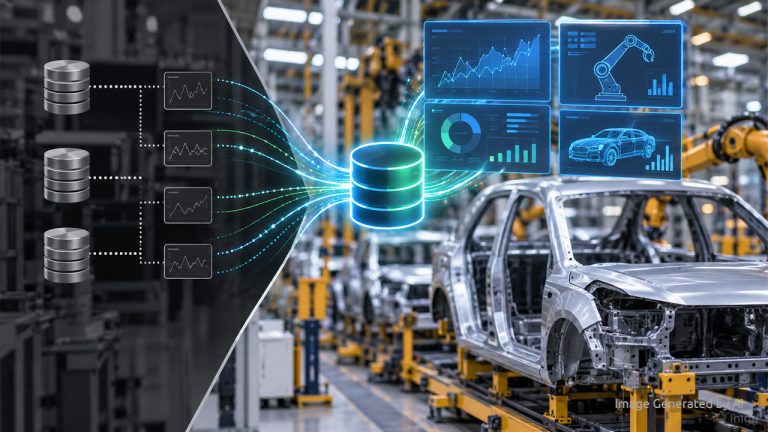
A major challenge manufacturers face is bridging the gap between vast volumes of raw operational data and actionable insights. That gap can only be closed through modern data architectures that blend edge intelligence with cloud-scale analytics.
Kaplan and Janakiraman agree that the modern data architecture in manufacturing must be hybrid. Real-time insights and sub-second decision-making must happen at the edge—close to the machines. But broader analytics, benchmarking across plants, and machine learning require the scale and compute of the cloud.
Snowflake’s role is to serve as the scalable cloud platform where this data is integrated, modeled, and analyzed. InfluxData, on the other hand, handles the collection and initial processing of time series data, often at the edge. Together, their platforms allow data to move fluidly, contextualized and structured for the right use case—whether it’s predictive maintenance, quality analytics, or operational optimization.
The Importance of Context and Standards
Manufacturing data is uniquely complex. With over 300 machine communication protocols and a wide range of PLC vendors and legacy systems, capturing clean, contextualized data is no small feat. Janakiraman emphasizes that without the right context, simply moving raw data from edge to cloud adds no value—it just shifts the swamp.
Both leaders stressed the importance of open standards and interoperability. InfluxData’s latest platform version is built on Apache Parquet and Iceberg—standards that integrate natively with Lakehouse architectures like Snowflake. This means manufacturers can use Snowflake’s powerful query engine to analyze time series data directly without custom ETL pipelines or format conversions.
Edge vs. Cloud? It’s Use-Case First
While “cloud-first” strategies are common in IT, IoT and manufacturing demand a different approach. As Janakiraman explains, real-world use cases determine where the intelligence should reside.
For vision-based quality control or high-speed production monitoring, edge analytics are essential. These decisions need to happen in milliseconds. But if a manufacturer wants to benchmark two plants or analyze long-term trends in performance, that analysis belongs in the cloud.
What matters most is flexibility—and a clear understanding that edge and cloud are not competitors but collaborators in a data-centric architecture.
A Collaborative Future for Industrial Intelligence
As manufacturers evolve toward more data-centric operations, platforms like InfluxData and Snowflake are not just complementary—they’re foundational. By integrating time series intelligence with enterprise-grade analytics, they enable manufacturers to build smarter systems faster, reduce manual effort, and unlock insights previously hidden in siloed systems.
The rise of open formats like Iceberg also paves the way for a more integrated ecosystem. Manufacturers can store, share, and analyze their data across platforms, reducing friction and maximizing value.
The message from Kaplan and Janakiraman is clear: start with the data. It’s no longer just a byproduct of operations—it is the blueprint for building better products, more efficient systems, and more resilient enterprises.
Sponsored by InfluxData
About the author
Lucian Fogoros is the Co-founder of IIoT World
Related articles:
FAQ
1. What is physical intelligence and how does it differ from digital twins?
According to Pugal Janakiraman of Snowflake, the role of data has evolved from supporting digital twins to becoming the foundation for physical intelligence. Physical systems such as robots, sensors, and production lines are no longer passive endpoints but active participants in an intelligent ecosystem where data fuels real-time decisions and continuous learning.
2. Why must modern manufacturing data architectures be hybrid rather than cloud-first?
Real-time insights and sub-second decision-making must happen at the edge, close to the machines, while broader analytics and benchmarking require the scale of the cloud. Vision-based quality control needs millisecond edge analytics, but comparing two plants’ performance belongs in the cloud.
3. Why is data contextualization so important in manufacturing environments?
Manufacturing data is uniquely complex, with over 300 machine communication protocols and a wide range of PLC vendors and legacy systems. Without the right context, simply moving raw data from edge to cloud adds no value. InfluxData’s latest platform is built on Apache Parquet and Iceberg to integrate natively with Lakehouse architectures.
Related from IIoT World: