
AI agents in manufacturing can now negotiate trade-offs between energy use, uptime, and quality in real time, without human intervention. According to Technology Advisor Omid Givehchi of ATELIC, this approach, called intelligent autonomy, keeps humans in command while AI handles continuous KPI balancing at the edge, where production data is generated.
That’s starting to change.
A new generation of AI agents at the edge is learning to understand context — the physical and operational conditions around every data point.
This shift is quietly changing how factories make decisions, manage trade-offs, and deliver value.
How Does Edge AI Interpret Factory Data?
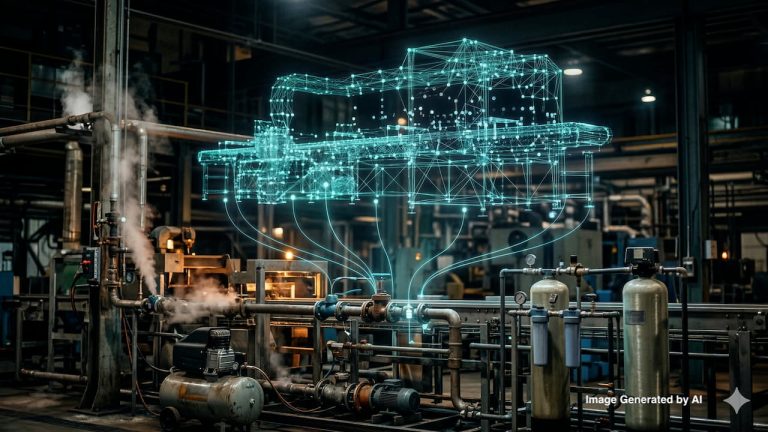
Edge AI interprets factory data by understanding context, beyond raw numbers. At the edge, close to where production happens, AI agents recognize whether a temperature spike signals a problem or is part of a normal cleaning cycle. This context-awareness allows instant decisions without waiting for human interpretation or central analytics.
This context allows the system to react instantly instead of waiting for human interpretation or central analytics.
Decisions happen where the data is born, saving time and preventing small deviations from turning into downtime.
What Is Intelligent Autonomy in Manufacturing?
Intelligent autonomy is automation that collaborates with human operators rather than replacing them. Omid Givehchi of ATELIC defines it as AI acting as a co-pilot: monitoring variables, suggesting adjustments, and handling repetitive tasks while operators retain oversight. The goal is faster, better decisions, with humans firmly in command.
AI acts as a co-pilot: monitoring every variable, suggesting adjustments, and handling repetitive tasks while operators stay focused on oversight and improvement.
It’s practical, transparent, and keeps humans firmly in command.
How Do AI Agents Balance Competing KPIs?
AI agents balance competing manufacturing KPIs by negotiating with each other continuously in the background. Each agent represents one metric: energy use, uptime, or quality. When energy costs rise, the energy agent proposes a slowdown; the uptime agent pushes back; together they reach a balance that protects both, without a spreadsheet or manual tuning.
AI agents can now change that dynamic.
Each agent represents a key performance indicator — one for energy, one for uptime, one for quality — and they negotiate with each other in real time.
If energy costs rise, the energy agent suggests a slowdown; the uptime agent pushes back; together they find the balance that protects both.
It’s not a spreadsheet exercise — it happens continuously in the background.
The result is smoother operations, lower waste, and measurable gains across all metrics, not just one.
How Does AI Speed Up IT/OT Integration?
Context-aware AI agents speed up IT/OT integration by translating automatically between old and new systems. Modern factories combine decades of technology, from legacy PLCs to cloud-based platforms that do not share a common language. AI agents understand both OT and IT environments and interpret data meaning, reducing integration timelines from months to days.
Context-aware AI agents now handle much of that translation automatically.
They understand both OT and IT environments and can interpret what the data means, not just how it’s formatted.
That’s how integration work that once took months now takes days — freeing engineers to focus on process improvements instead of chasing protocol mismatches.
How Does Edge AI Deliver Measurable ROI?
Edge AI delivers measurable ROI by tying decisions directly to production outcomes. Because edge intelligence operates close to the operation, it reduces energy use, minimizes downtime, and improves product consistency. When AI systems are connected to measurable results, they move from experimental projects to standard components of production strategy.
When AI systems are tied directly to measurable outcomes, they stop being “innovation projects” and become part of a standard production strategy.
What Are the Benefits of AI Agents in Factories?
Manufacturers adopting AI agents at the edge gain four concrete operational benefits: fewer interruptions and quicker recovery from issues; balanced KPIs without constant manual tuning; easier IT/OT integration across legacy and modern systems; and real ROI from every digital initiative tied directly to production outcomes.
For manufacturers, that means:
- Fewer interruptions and quicker recovery
- Balanced KPIs without constant manual tuning
- Easier IT/OT integration
- Real ROI from every digital initiative
In simple terms: factories that think a little more like people — aware, responsive, and always learning.
Source: IIoT World CXO Insights interview with Omid Givehchi, Technology Advisor at ATELIC. (October 2025).
Related articles:
FAQ
1. What is intelligent autonomy in manufacturing AI?
Intelligent autonomy is a model of AI deployment where automation collaborates with human operators rather than replacing them. Defined by Omid Givehchi of ATELIC, it positions AI as a co-pilot: monitoring variables, suggesting adjustments, and managing repetitive tasks while operators retain full oversight. The approach is transparent, practical, and keeps humans in command of production decisions.
2. How do AI agents negotiate between energy, uptime, and quality?
Each AI agent represents a single KPI, such as energy use, uptime, or product quality. When conditions change, for example when energy costs rise, the energy agent proposes a production slowdown. The uptime agent pushes back. The agents negotiate in real time to find a balance that protects both metrics. This happens continuously in the background, replacing manual trade-off decisions that previously required operator intervention.
3. Edge AI vs. centralized analytics: what is the difference in manufacturing?
Edge AI processes data close to where production happens, supporting instant decisions without sending information to a central system first. Centralized analytics requires data to travel off the floor before interpretation, introducing latency. In manufacturing, edge AI agents can distinguish a normal cleaning-cycle temperature spike from a fault condition in real time, preventing small deviations from becoming costly downtime.
4. Why do factory IT/OT integration projects take so long?
Factory IT/OT integration is slow because modern facilities combine decades of equipment, with legacy PLCs and cloud-based systems that do not share a common data language. Traditionally, bridging these required long, manual integration projects. Context-aware AI agents, as described by ATELIC advisor Omid Givehchi, can interpret data meaning across both environments automatically, reducing integration timelines from months to days.
Related Reading
Industrial IoT Law – IIoT Legal and Regulatory Aspects
Humanoid Robots in Manufacturing: 2026 Data
Prescriptive AI That Respects Reality: Recommendations You Can Actually Execute