
What Edge AI Needs from Industrial Data
· Smart Manufacturing

What Edge AI Needs from Industrial Data

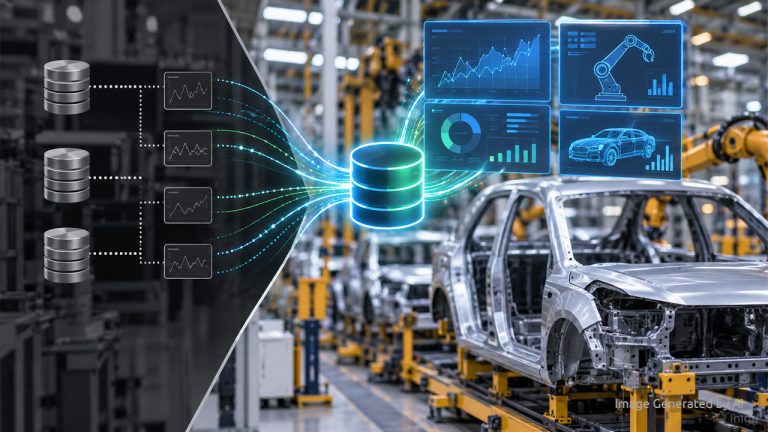
A temperature reading with a timestamp does not tell you whether it is Fahrenheit or centigrade, which factory generated it, which production line, or which asset. Without that context, the data cannot drive a decision. At Hannover Messe 2026, InfluxData and Litmus described how their integrated architecture solves this: Litmus Edge connects to shop floor […]

Read more →
Factory Integration: From 90 Days to One Week
· Industrial IoT

Factory Integration: From 90 Days to One Week

Most factories are sitting on a goldmine of machine data that never reaches the people who need it, because the middleware stack between the PLC and the dashboard takes a full quarter to configure. Coreflux, a startup based in Porto, Portugal, consolidates the typical five or six integration tools into a single MQTT broker running […]

Read more →
Managing Battery Storage Data from Cell Level to Fleet
· Energy

Managing Battery Storage Data from Cell Level to Fleet

A battery cell is roughly the size of a cell phone. A battery enclosure is the size of a shipping container. A single site can have thousands of those containers, and for each individual cell inside, operators need state of charge and state of health readings every one to 10 seconds, or even faster during […]

Read more →
Case Study: From 2 Production Updates a Year to 2 a Day
· Smart Manufacturing

Case Study: From 2 Production Updates a Year to 2 a Day

A German automotive manufacturer with 37,000 employees and 3 production sites used to stop the line for up to three hours every time it needed a configuration update. Each update cost between €280,000 and €1,700,000. The risk was so high that updates only happened twice a year, during production holidays. Today, the same manufacturer deploys […]

Read more →
Why Sensor Origin Now Matters in Manufacturing
· Connected Industry

Why Sensor Origin Now Matters in Manufacturing

Sensor origin has never been a line item on factory procurement specs. Quality and price decided everything. According to Dr. Antoine Filipe, CTO of Tronics Microsystems, a TDK Group Company, that is changing. Tariff disruptions, tightening export controls, and China’s rare earth restrictions are forcing manufacturing procurement teams to ask a question their aerospace counterparts […]

Read more →
Removable Media Is Still OT’s Biggest Blind Spot
· Cybersecurity

Removable Media Is Still OT’s Biggest Blind Spot

A plant operator plugged a personal phone into an HMI to charge it and accidentally tethered the device, giving an air-gapped control system a live internet connection. At another site, the cybersecurity lead walked through the front gate wearing a USB drive on a lanyard at a facility with a strict no-USB policy. These are […]

Read more →
What “AI-Ready” Actually Means for Distributed Energy Systems
· Artificial Intelligence & ML

What “AI-Ready” Actually Means for Distributed Energy Systems

There certainly is no shortage of interest in applying AI to distributed energy operations. Battery storage operators want predictive analytics at the cell level. Renewable fleet managers want optimization recommendations across hundreds of sites. Grid operators want faster fault diagnostics closer to the asset. The ambition is real, and the use cases are sound.But ambition […]

Read more →
Implementing Edge AI for Asset Health Monitoring in Energy Infrastructure
· Energy

Implementing Edge AI for Asset Health Monitoring in Energy Infrastructure

Edge AI enables energy companies to monitor aging brownfield infrastructure by processing sensor data locally, replacing the diagnostic expertise lost as experienced engineers retire. At IIoT World Energy Day, panelists from TDK SensEI, HiveMQ, PrivacyChain, and ARC Advisory Group outlined the operational frameworks required to deploy Edge AI for maintaining infrastructure uptime, covering prescriptive analytics, […]

Read more →
How Agentic AI Changes Factory Data Requirements
· Artificial Intelligence & ML

How Agentic AI Changes Factory Data Requirements

Most factory data architectures today serve between 10 and 50 consuming systems. Agentic AI will push that number into the thousands, a 100x increase in edge-based data consumers. The ISA-95 layer-by-layer model was not designed for this volume, and manufacturers need to rethink their data infrastructure before scaling AI agents. IDC reports that 56.6% of […]

Read more →
Why Your Factory’s AI Keeps Failing: The One Document You Forgot
· Artificial Intelligence & ML

Why Your Factory’s AI Keeps Failing: The One Document You Forgot

You installed the sensors. You bought the AI license. You hired the data scientist. Yet your million-dollar pilot is stuck, delivering quirky answers that no one on the floor dares to trust. The problem isn’t your algorithm. It’s the coffee-stained, handwritten maintenance log from 1998 that your new AI has no idea how to read.In […]

Read more →
Industrial Foundation Models Could Become Europe’s Strongest Manufacturing Advantage
· Artificial Intelligence & ML

Industrial Foundation Models Could Become Europe’s Strongest Manufacturing Advantage

Manufacturing knowledge is fragmented and mostly unusedEuropean manufacturers collectively hold decades of deep production knowledge: how materials behave, how machines are tuned, how quality issues emerge, how processes fail and recover. Yet this knowledge remains locked inside individual companies, plants, and teams. It is applied locally, rarely reused, and almost never scaled.At the same time, […]

Read more →
The Signal vs. Noise Ratio: Solving Alert Fatigue in the Modern Factory
· Artificial Intelligence & ML

The Signal vs. Noise Ratio: Solving Alert Fatigue in the Modern Factory

In 2026, the primary barrier to manufacturing efficiency is the abundance of data. Modern plants now monitor tens of thousands of assets and hundreds of thousands of individual points. However, this connectivity has created a new operational hazard: Alert Fatigue. When a plant manager receives thousands of notifications a day, the most critical “signal” is often […]

Read more →