Generative AI is no longer a future promise for manufacturers; it is an active force reshaping how factories sense, adapt, and optimize production in real time. In this strategic guide, IIoT World maps the journey from early data-driven ambitions to fully sensing factory environments where generative models autonomously create production schedules, design process improvements, and generate maintenance instructions from unstructured data. The article breaks the transformation into actionable phases, identifies the organizational capabilities required at each stage, and addresses the most common failure modes that derail industrial generative AI initiatives. If you are a manufacturing leader trying to move beyond proof-of-concept projects and wondering how to build a scalable, enterprise-wide AI strategy, this framework provides the structured path forward.
At Hannover Messe 2025, Helena Jochberger, Vice President and Global Industry Lead of Manufacturing, CGI, joined IIoT World for a timely conversation on the future of AI in manufacturing. With decades of experience guiding industrial transformation, she laid out a pragmatic roadmap for how generative AI, when implemented responsibly and supported by strong data governance, can enable manufacturers to move from digital aspirations to tangible impact.
Generative AI: From Task Automation to Goal-Oriented Intelligence
Manufacturing isn’t new to AI. In fact, many factories have been automating decisions since the ISA-95 framework gained traction in the mid-1990s. Over time, robotic process automation (RPA) became widespread, primarily focused on task execution.
What’s changing now is the shift from rule-based automation to goal-driven intelligence. Generative AI goes beyond performing tasks; it adapts to objectives. That leap—toward goal-oriented automation—represents a significant evolution in how manufacturing systems can operate with increased autonomy, speed, and precision.
Why Data Strategy Is the Real Enabler of AI
Despite growing excitement around AI, many manufacturers still struggle to unlock its full potential due to one foundational gap: data readiness.
Jochberger emphasizes that data is the “little brother of AI”—and without mature data governance, AI initiatives fall short. Manufacturers must:
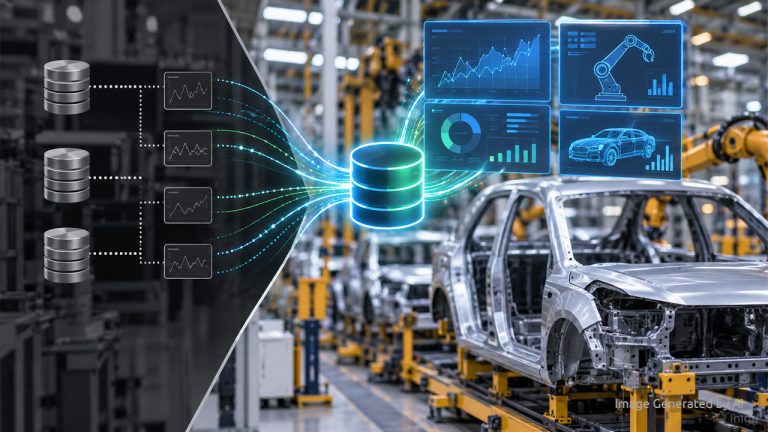
- Establish digital continuity across ERP, MES, and aftersales systems
- Eliminate data silos that hinder insight generation
- Tailor data models to specific use cases across R&D, supply chain, and production
A clear, scalable data integration strategy is no longer optional—it’s the backbone of effective AI deployment in Industry 5.0.
Use Case: Accelerating Complex Product Development
One high-impact use case shared during the conversation involves using generative AI to accelerate design cycles for complex systems like aircraft or ships.
Manufacturers can streamline ticketing processes between design and production teams by plugging large language models (LLMs) into internal knowledge databases. The result? Faster iterations, fewer bottlenecks, and reduced time-to-market.
This early adoption of generative AI in R&D is a blueprint for manufacturers seeking measurable ROI from emerging technologies.
AI-Powered Supply Chains Need Real-Time Data—and Trust
Supply chain resilience remains a top priority for manufacturers. CGI’s work in this space highlights the growing demand for:
- Real-time data exchange between OEMs and suppliers
- Shared data standards across ecosystems
- Data sovereignty—giving organizations control over what they share and when
This transparency enables dynamic, demand-driven adjustments in production and inventory, allowing manufacturers to respond faster to disruptions or spikes in customer demand.
Looking Ahead: The Rise of the Sensing Factory
As digital maturity increases, the next leap is toward sensing factories—environments where end-to-end digital processes continuously learn, adapt, and self-optimize in real-time.
Helena Jochberger envisions a manufacturing floor where AI, IoT, and data systems form a responsive ecosystem, closing feedback loops without human intervention. But this future hinges on the work done today: integrating systems, aligning on standards, and preparing data for advanced AI use.
Responsible AI Is Human-Centric AI
While the potential is vast, the ethical dimensions of AI must remain central. Helena Jochberger reminds us that AI is a tool, not the goal. Responsible use requires:
- Risk assessment frameworks
- Transparent, explainable models
- Human oversight and collaboration
As Industry 5.0 unfolds, manufacturers must anchor innovation in human values—ensuring that AI augments, not replaces, human expertise.
Key Takeaways for Industrial Leaders
- Start with a robust data strategy—AI success depends on data quality, integration, and governance.
- Generative AI offers real-world value, especially in reducing R&D and supply chain cycle times.
- The future of manufacturing is a “sensing factory,”—but it requires investment in connectivity and real-time intelligence today.
- Responsible AI is not just a compliance issue—it’s essential to long-term trust, usability, and business value.
About the author
 This article was written by Greg Orloff, Industry Executive, IIoT World. Greg previously served as the CEO of Tangent Company, inventor of the Watercycle™, the only commercial residential direct potable reuse system in the country.
Related articles:
FAQ
1. How is generative AI different from traditional AI in manufacturing?
Traditional AI in manufacturing is predominantly analytical: it classifies defects, predicts failures, and optimizes known parameters within predefined boundaries. Generative AI goes a step further by creating new outputs, such as synthetic training data for vision models, novel process recipes, automated work instructions, and even equipment design iterations. In practice, this means a generative model can draft a complete changeover procedure for a production line by synthesizing historical maintenance logs, OEM manuals, and operator notes. This capability dramatically reduces the time engineers spend on documentation and knowledge transfer, with early adopters reporting 40% to 60% reductions in technical content creation time.
2. What does a “sensing factory” mean in the context of this framework?
A sensing factory is the most mature stage of the AI adoption framework described in this article. It refers to a production environment where interconnected sensors, edge AI models, and generative systems work together to continuously perceive, interpret, and respond to operational conditions without manual intervention. In a sensing factory, data from vibration sensors, thermal cameras, MES systems, and ERP platforms feeds into AI orchestration layers that generate real-time decisions. The distinction from earlier stages is autonomy: rather than surfacing dashboards for human review, the sensing factory generates and executes optimized actions, escalating to humans only when confidence thresholds are not met. Achieving this state typically requires 18 to 36 months of foundational data infrastructure work.
3. What are the biggest pitfalls when scaling generative AI in manufacturing?
Three pitfalls dominate failed scaling efforts. First, data fragmentation across siloed MES, SCADA, and ERP systems prevents generative models from accessing the cross-functional context they need to produce accurate outputs. Second, organizations often underestimate the domain expertise required to validate AI-generated content; without structured human-in-the-loop review processes, errors in generated work instructions or process parameters can propagate to the shop floor. Third, many manufacturers attempt enterprise-wide rollouts before establishing robust model governance, including version control, drift detection, and bias auditing. Companies that address these three areas before scaling consistently report higher adoption rates and faster time to value.
Related from IIoT World: